


A Heist That Shocked the World
On a quiet Sunday morning in Paris, October 19, 2025, the world’s most famous museum—the Louvre—woke up to one of the boldest heists in modern history. Within just seven minutes, four masked men used power tools to break into the museum’s Apollo Gallery and vanished with treasures valued at nearly $102 million.
The Louvre, home to the Mona Lisa and countless priceless artifacts, is visited by more than 30,000 people every day. But that morning, its heavy security system failed in ways no one could have imagined.
The Morning of the Heist
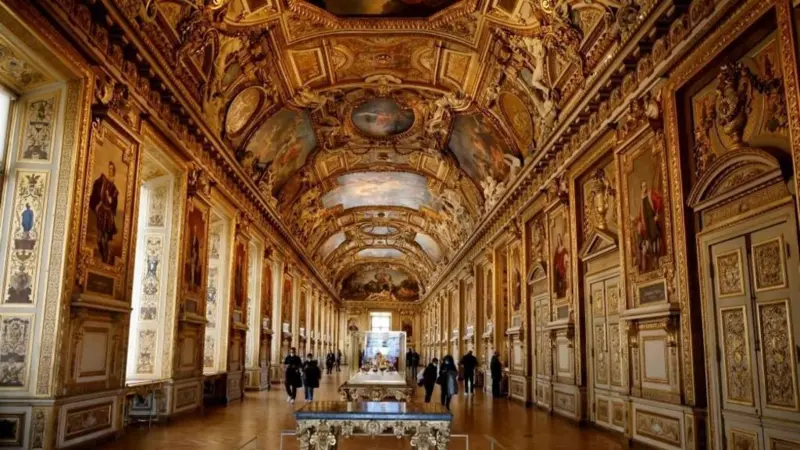
According to French authorities, the robbery took place at around 9 a.m., just before the museum opened to the public. Witnesses reported hearing unusual mechanical noises from the direction of the Apollo Gallery—home to the French Crown Jewels and royal treasures dating back centuries.
The thieves reportedly used a forklift and power tools to breach a side window facing the Seine River. Once inside, they navigated directly toward specific display cases—an indication that they knew exactly what they wanted. Within minutes, alarms sounded, but by the time guards arrived, the culprits had already escaped on motorbikes, disappearing into the streets of Paris.
Two Arrests After International Manhunt
Within a week of the heist, police arrested two suspects—one at Charles de Gaulle Airport while attempting to flee to Algeria, and another trying to board a flight to Mali. French prosecutors confirmed both were under 96-hour custody for interrogation.
DNA evidence found at the scene helped identify one of the suspects. Investigators believe at least four people were directly involved, with possible links to international art trafficking networks operating across Europe and North Africa.
The stolen artifacts, believed to include historic jewels once owned by Napoleon’s family, remain missing.
An Embarrassment for France’s Security Apparatus
France’s Minister of Justice called the theft a “failure of national security,” admitting that such a high-profile breach tarnished the country’s global image. The Minister of Culture, Rachida Dati, confirmed the incident in a public post, saying the heist occurred “as the museum was preparing to open.”
Officials were quick to close the museum for a full day, citing “special circumstances.” Security footage is being analyzed to understand how the intruders bypassed multiple layers of defense—infrared sensors, motion detectors, and round-the-clock guards.
A Seven-Minute Operation
According to preliminary reports, the thieves entered the museum using a movable ladder to reach the upper level. Once inside, they smashed reinforced glass cases and took away multiple royal ornaments and gemstones.
French Interior Minister Laurent Nuñez revealed that the operation lasted “no more than seven minutes.” Despite the museum’s sophisticated alarm system, the thieves displayed exceptional coordination and insider knowledge—raising speculation that someone within the museum might have assisted them.
Why the Apollo Gallery?
The Apollo Gallery is among the most iconic sections of the Louvre. It houses relics from the French monarchy, including jewels and regalia that survived the French Revolution. Some of the most valuable pieces stored there are the Regent, Sancy, and Hortensia diamonds—gems known for their rarity and royal lineage.
These objects hold not only immense monetary value but also cultural and historical importance. Their loss represents a devastating blow to France’s heritage.
The Louvre: More Than a Museum
Built in 1546 as a royal palace for King Francis I, the Louvre was transformed into a public museum in 1793, following the French Revolution. Spanning over 73,000 square meters—roughly the size of ten football fields—it remains the largest art museum in the world.
The museum attracts over 10 million visitors annually, with Leonardo da Vinci’s Mona Lisa serving as its most famous exhibit. Other masterpieces include the Venus de Milo and the Winged Victory of Samothrace.
However, this heist has raised questions about whether the museum’s size and complexity have made it vulnerable to modern criminals.
History Repeats Itself: The Mona Lisa Theft
The Louvre has seen major thefts before. In 1911, Leonardo da Vinci’s Mona Lisa was stolen by an Italian handyman named Vincenzo Peruggia, who believed the painting belonged in Italy. The artwork was recovered two years later in Florence, turning the Mona Lisa into a global icon.
In 1983, 16th-century armor pieces disappeared from the museum and were recovered only decades later. In 1998, the painting The Savior Road by Camille Corot was stolen and remains missing to this day.
These incidents show that even the most secure institutions can be vulnerable.
A Crime of Precision and Symbolism
Experts say the Louvre heist was not just about money, but about symbolism. “Stealing from the Louvre is a statement,” says art crime analyst Dr. Pierre Leclerc. “It’s a message to the world: even the most guarded treasures can be taken.”
The theft’s surgical precision suggests a well-financed criminal syndicate, possibly with access to insider information. Investigators are exploring whether the thieves planned to sell the jewels on the black market, or melt them down to erase traceability.
The Global Art Black Market
Art theft is a multibillion-dollar industry, ranking third globally after drugs and weapons trafficking. Stolen art often resurfaces years or even decades later in underground auctions, private collections, or through forged documents.
Interpol estimates that over 50,000 artworks are stolen annually worldwide. Recovering them is difficult, as many pieces are smuggled across borders or altered beyond recognition.
The Louvre heist, therefore, fits a disturbing pattern—one that connects Paris to global criminal networks spanning from Europe to the Middle East.
Aftermath: Security Overhaul and Public Outrage
Following the theft, the Louvre announced immediate steps to strengthen security, including AI-assisted surveillance, new entry protocols, and digital tracking of high-value items.
The French public reacted with shock and anger. Many questioned how such a theft could occur in broad daylight in the heart of Paris. For a country that prides itself on culture and art, the incident was not just a crime—it was a national humiliation.
The Mystery of the Missing Jewels
Police later found a single jewel near the scene, possibly dropped during the heist. Investigators have not confirmed which artifact it was. The recovery of even one piece, however, gives hope that the stolen items might resurface.
Authorities have contacted international agencies, including Europol and Interpol, to track the movement of any rare jewels that match the missing pieces’ description.
What Lies Ahead for the Louvre
The Louvre reopened a day after the theft, but security remained tight. Visitors noticed visible police presence, sealed sections, and restricted gallery access. Officials vowed to restore public confidence.
The museum’s administration announced plans for a digital registry of every artifact, complete with 3D imaging, to help identify stolen items more easily in the future.
A Lesson for the World’s Museums
This heist is a wake-up call for cultural institutions worldwide. Museums hold not only art but history, and protecting them requires more than alarms—it requires anticipation.
The “Seven-Minute Heist” will likely become a case study in museum security failures, demonstrating how even advanced technology cannot replace vigilance, training, and preparedness.
Public Reaction and Cultural Impact
The theft dominated international headlines for weeks. Artists, historians, and politicians debated the meaning behind such crimes. Some compared it to the theft of national identity—arguing that when cultural artifacts are stolen, history itself is endangered.
For ordinary people, it was simply unimaginable: how could someone rob the Louvre, a symbol of human civilization, in just seven minutes?
Key Takeaways
The Louvre Heist 2025 was executed in under seven minutes.
$102 million worth of royal jewels were stolen.
Two suspects arrested while attempting to flee abroad.
French government faces criticism for security lapses.
The stolen items include historically significant jewels from Napoleonic France.
The Louvre plans a complete security overhaul using AI and digital tracking.
Frequently Asked Questions (FAQs)
1. What exactly was stolen from the Louvre in 2025?
Authorities confirmed that several historic jewels and ornaments from the Apollo Gallery were stolen, including items believed to belong to Napoleon’s family. Their total value is estimated at $102 million.
2. How did the thieves manage to enter the museum?
They reportedly used a forklift to reach a window on the upper floor and power tools to break in, completing the operation in just seven minutes.
3. Has anyone been arrested in connection with the theft?
Yes. Two suspects were arrested—one at Charles de Gaulle Airport and another attempting to flee to Mali. The investigation remains ongoing.
4. Why is the Louvre Heist significant?
Because the Louvre is the most visited museum in the world, the theft represents both a cultural and symbolic attack on France’s heritage.
5. How has the museum responded?
The Louvre temporarily closed for 24 hours and announced plans to modernize its security infrastructure with AI and digital asset tracking.
6. Is there a history of theft at the Louvre?
Yes, including the famous 1911 theft of Leonardo da Vinci’s Mona Lisa and other incidents over the past century.









Responses (0 )