


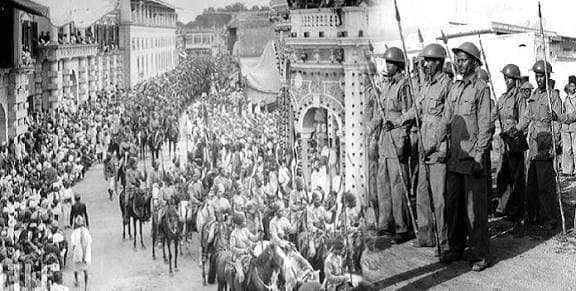
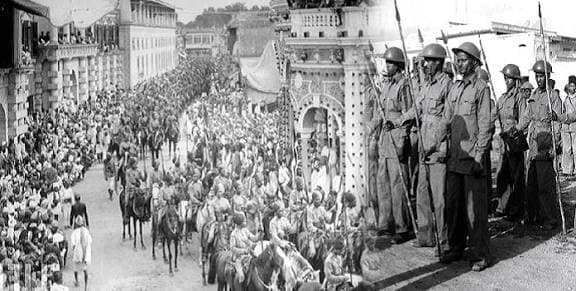
Operation Polo and the Liberation of Hyderabad
By 1947, India had become independent, but Hyderabad remained outside the Indian Union. The Nizam insisted on being independent, even though his state was geographically surrounded by Indian territory. This created a serious threat to the unity and security of India.
The Political Deadlock
India’s Deputy Prime Minister and Home Minister, Sardar Vallabhbhai Patel, strongly believed that Hyderabad must join India. For him, the existence of an independent Hyderabad within Indian territory was unacceptable.
The Indian government tried negotiating with the Nizam. An agreement called the “Standstill Agreement” was signed in November 1947. It was meant to maintain the status quo for one year, while further discussions continued.
But the Nizam used this period to strengthen his forces and expand the Razakar militia. Instead of moving closer to India, Hyderabad became more rebellious.
Escalation of Violence
During 1947–48, the Razakars increased their attacks on villages in Marathwada, Telangana, and parts of Karnataka. They targeted anyone who expressed loyalty to India. Thousands of families were displaced, women were subjected to atrocities, and entire villages were burned down.
Reports of massacres shocked the nation. The situation was spiraling out of control, and the Indian government could no longer remain silent.
The Indian Army Steps In
On 13th September 1948, the Indian Army launched a military action against the Nizam’s forces. This operation was code-named “Operation Polo” because Hyderabad was often referred to as the land of polo grounds.
The campaign was swift and decisive. In just five days, the Indian Army defeated the Nizam’s forces and disbanded the Razakar militia. On 17th September 1948, the Nizam surrendered, and Hyderabad was officially integrated into the Indian Union.
The Role of Marathwada
For the people of Marathwada, this was a day of unparalleled joy. After years of oppression, humiliation, and bloodshed, they finally became free citizens of independent India. Villages celebrated by hoisting the Indian tricolor, singing patriotic songs, and honoring the martyrs who had laid down their lives.
17 September 1948 – Marathwada Mukti Sangram Din
The liberation of Marathwada on 17 September is not just a historical date; it is a symbol of courage, unity, and sacrifice. Unlike most parts of India, which became free in 1947, Marathwada had to wait for another year.
On this day:
The Nizam’s oppressive rule ended.
The Razakar terror was crushed.
People of Marathwada joined the Indian Republic with dignity.
Since then, 17th September is observed as Marathwada Mukti Sangram Din (Marathwada Liberation Day). It is not merely a celebration of military victory, but a remembrance of the sacrifices made by farmers, students, women, and ordinary citizens who fought for freedom.
Martyrs and Unsung Heroes
Every liberation struggle is carried on the shoulders of martyrs. The Marathwada movement saw hundreds of brave souls sacrifice their lives.
Swami Ramanand Tirtha – Though not martyred, his leadership gave spiritual strength to the people.
Govindbhai Shroff – Imprisoned several times, he was the voice of resistance.
Digambar Rao Bindu – Inspired youth movements in Latur.
Annasaheb Laturkar – Mobilized farmers and peasants.
But beyond these names, there were countless unsung heroes – farmers who refused to pay unjust taxes, women who sheltered satyagrahis in their homes, young boys and girls who carried secret messages, and villagers who gave their lives in Razakar attacks.
Their sacrifices may not be written in history books, but they live on in the collective memory of Marathwada.
Impact of Liberation
The liberation of Marathwada brought immense changes:
End of Feudal Oppression: Forced labor, unjust taxation, and feudal practices were abolished.
Democratic Rights: People were now free to vote, express themselves, and participate in governance.
Education and Social Reform: Schools and colleges flourished, literacy improved, and social reforms gained momentum.
Integration with Maharashtra: In 1956, with the formation of the linguistic state of Maharashtra, Marathwada became part of it, reconnecting with the Marathi cultural identity.
✅ That’s Part 3. Now we’ve covered:
Part 2: Freedom Struggle in Marathwada
👉 Next, I can continue with Part 4: How Marathwada Mukti Sangram Din is Celebrated Today, Its Political and Cultural Significance, and the Relevance of This Struggle in Contemporary India.








Responses (0 )