


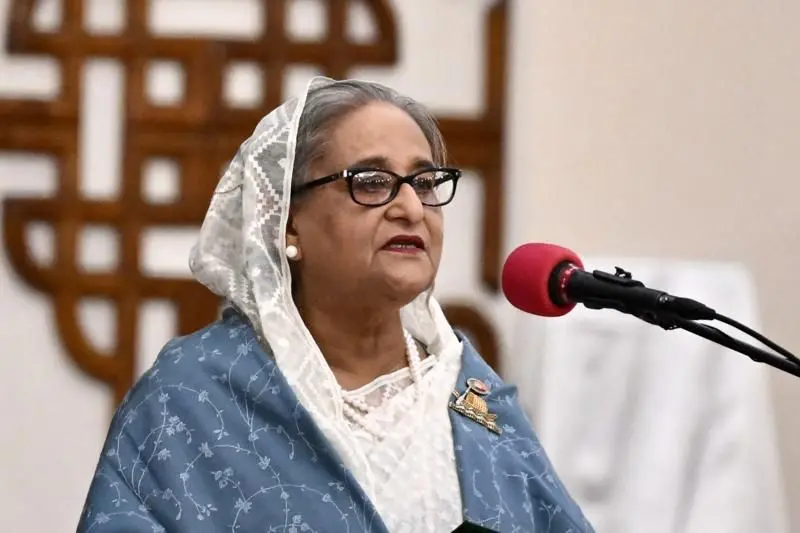
Bangladesh’s former Prime Minister Sheikh Hasina has been sentenced to death after being found guilty in cases linked to crimes against humanity. The verdict has triggered intense political reactions across the country, with her party, the Awami League, condemning the decision and calling it politically motivated and driven by revenge.
Soon after the announcement, the Awami League released an official statement expressing deep concern and urging the public to resist what they termed an “unjust and vindictive verdict.”
The party declared:
A nationwide shutdown on November 18
Mass protests from November 19–21 across the country
Awami League’s Allegations Against the Interim Government
The Awami League strongly criticized the interim administration led by Mohammad Yunus, accusing it of seizing power through unconstitutional and illegal means.
According to their statement:
The current government is not elected by the people
The tribunal that delivered the verdict was created illegally
The judgment was motivated by political revenge
The charges against Sheikh Hasina are nothing but a fabricated drama
The party also questioned the integrity of the special tribunal that delivered the verdict, calling it “fully illegal, biased, malicious, and driven by vengeance.”
Bangladesh Requests India to Extradite Sheikh Hasina
Following the verdict, Bangladesh formally requested India to extradite Sheikh Hasina and former Home Minister Asaduzzaman Khan Kamal, both of whom are currently living in India.
In response, India stated:
It has taken note of the court’s verdict
As a close neighbor, India remains committed to supporting peace, democracy, stability, and inclusiveness in Bangladesh
India will maintain dialogue with all stakeholders in Bangladesh
Bangladesh, on the other hand, argued that giving shelter to individuals convicted of crimes against humanity is not a “friendly gesture” and is a serious “breach of justice.”
Sheikh Hasina Responds to the Death Sentence
Sheikh Hasina strongly condemned the judgment, calling it biased, unjust, and politically motivated.
A five-page statement issued on her behalf declared:
The death sentence is an attempt to eliminate the Awami League as a political force
She is not afraid to face any fair and impartial judicial trial
All allegations against her are false
If the government believes the charges, it should present them before the International Criminal Court (ICC) in The Hague
She previously described the entire process as a “drama” orchestrated to discredit her politically.
What Happened Inside the Court?
As the verdict was announced, large crowds gathered both inside and outside the court premises. People shouted slogans and many celebrated the judgment, prompting authorities to restore order and ask the public to maintain decorum.
The verdict was read in six sections, spanning 453 pages, and was broadcast live across the country, marking one of the most closely watched court proceedings in Bangladesh in recent times.
Background to the Case: Violent Protests and Serious Allegations
The charges stem from violent anti-government protests that erupted in July–August last year. According to the prosecution:
Over 1,400 people were killed
Nearly 25,000 were injured
Protesters, including students, were targeted in several regions
Prosecutors presented hundreds of pages of evidence, witness statements, and documentation to support the charges.
Sheikh Hasina, Asaduzzaman Khan Kamal, and others were accused of:
Planning and ordering targeted killings
Encouraging attacks on civilians
Supporting armed groups aligned with the ruling party
Attempting to suppress dissent through systematic violence
Major Incidents Mentioned in the Charges
Sheikh Hasina and other accused individuals were specifically charged with involvement in:
The murder of university student Abu Sayeed in Rangpur
The killing of six civilians in Dhaka’s Chankharpul area
The killing and burning of five individuals in Ashulia
Burning another victim alive
Systematic violence across multiple districts
These actions, according to the tribunal, constituted crimes against humanity, leading to the severe sentences.
Sentences Announced
The tribunal issued the following punishments:
Sheikh Hasina:
Death sentence in two of five charges
Life imprisonment in the remaining charges
Former Home Minister Asaduzzaman Khan Kamal:
Death sentence
Former Police Chief Abdullah Al Mannan:
Five years imprisonment (after turning state witness)
Political Turmoil and Exile
During the violent protests last year, Sheikh Hasina lost power in August 2024 and fled Bangladesh. Since then, she has been living in India.
The charges against her were finalized in June, after which the tribunal proceeded with the trial in her absence.









Responses (0 )