


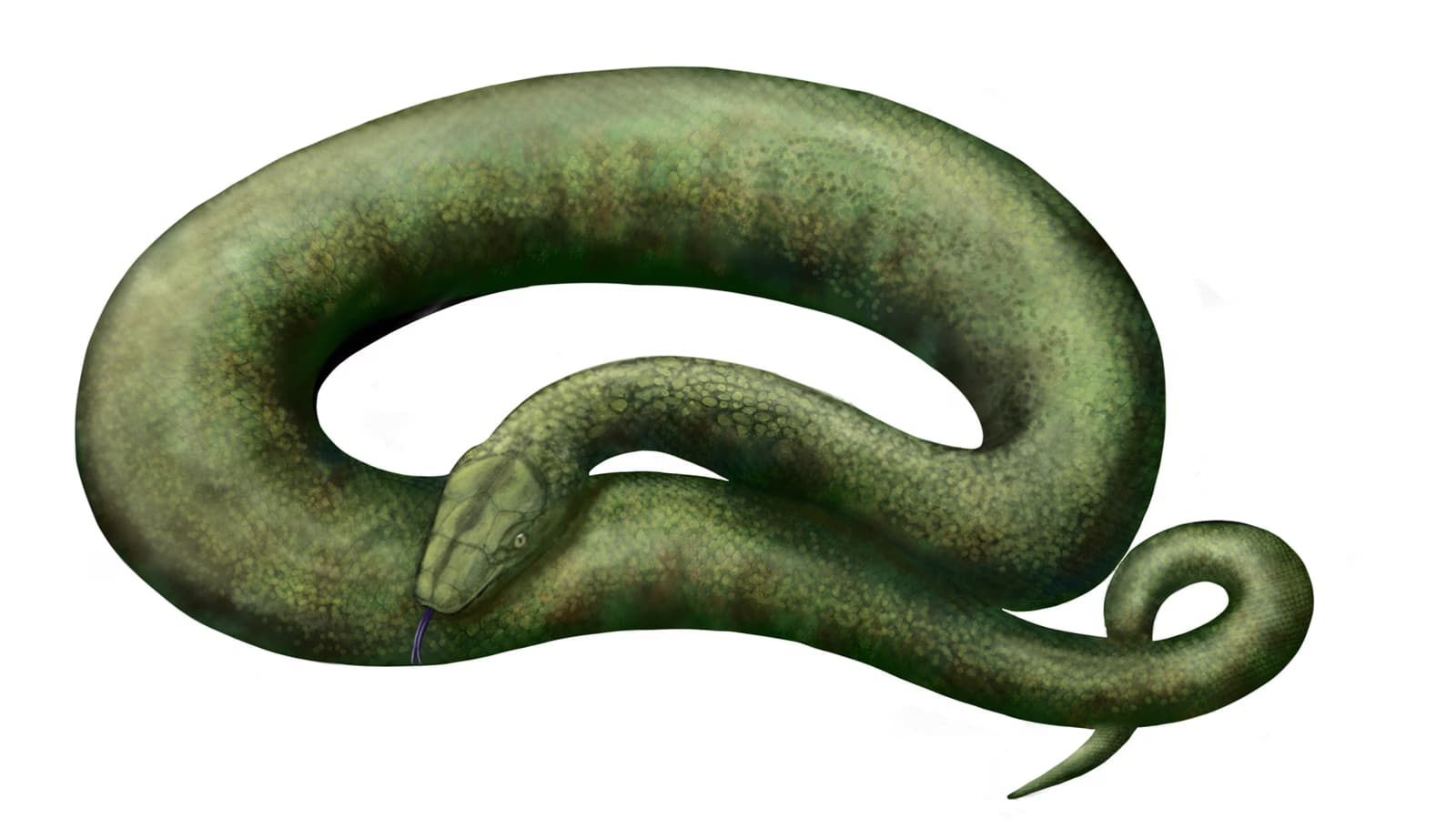
In 2005, paleontologist Dr. Sunil Bajpai embarked on an expedition in Gujarat’s Kutch district to study ancient whale fossils. What he and his team eventually uncovered turned out to be far more extraordinary—a discovery that rewrote the history of prehistoric reptiles in India. Hidden in a coal mine were fragments of a colossal creature’s vertebrae, later identified as belonging to a giant 49-foot serpent that lived around 47 million years ago.
This serpent, now named Vasuki Indicus, is one of the largest snake species ever discovered—an ancient reptile that slithered across the Indian subcontinent long before the Himalayas even existed.
The Forgotten Fossils
When Dr. Bajpai first found the remains, he assumed they belonged to a crocodile. The fossils were set aside and remained unexamined for nearly 18 years.
“We believed they were crocodile bones,” said Dr. Bajpai. “It wasn’t until researcher Debajit Datta and I revisited our old collection that we realized the unique markings on the fossils resembled those of a snake, not a crocodile.”
That revelation sparked a new phase of study—one that revealed the anatomy, ecology, and evolutionary importance of this prehistoric serpent. The scientists named it Vasuki Indicus, after Vasuki, the mythical serpent king in Hindu mythology who coiled around Lord Shiva’s neck.
Anatomy of a Prehistoric Giant
Detailed analysis revealed that Vasuki Indicus lived during the Eocene epoch, approximately 47 million years ago. The fossilized vertebrae indicated that the snake could have measured between 11 to 15 meters (36 to 49 feet) in length, placing it among the longest snakes ever to exist.
Although incomplete, the fossils show a body structure similar to today’s mountain-dwelling snakes. “Its vertebral patterns suggest a strong and flexible spine,” explained Datta. “This means it likely moved and hunted like modern pythons or boas.”
Hunting Like a Python
How did this prehistoric serpent hunt?
According to the researchers, Vasuki Indicus was not an active predator that chased its prey. Instead, it used an ambush strategy—waiting patiently for unsuspecting animals to come close, then constricting and suffocating them before swallowing them whole.
“The snake probably lived in swampy or marshy areas,” Datta added. “It might have wrapped itself around prey such as early mammals or reptiles, tightened its coils, and then consumed them.”
Like modern constrictors, Vasuki’s hunting technique relied on brute strength, not venom. The fossil site, which also contained remains of ancient whales, sharks, crocodiles, and turtles, suggests that the region was once a coastal or marine environment.
Older Than the Himalayas
One of the most fascinating aspects of the discovery is the serpent’s age. Dr. Bajpai explains that Vasuki Indicus existed 18 million years after the extinction of dinosaurs—a period when the Indian subcontinent was still drifting toward Asia.
“This snake lived before the formation of the Himalayas,” Bajpai said. “The tectonic collision between the Indian and Asian plates had just begun, but the mountain range was not yet formed.”
In other words, Vasuki Indicus roamed the land before the Himalayas rose from the Earth’s crust. Its existence provides valuable clues about the environmental and geological transformations that occurred during the Eocene period.
A Climate of Giants
During Vasuki’s time, India was a tropical landmass teeming with life. The humid, warm climate provided ideal conditions for the growth of large reptiles. Vasuki likely shared its habitat with early whales (archaeocetes) and primitive crocodiles, thriving in ecosystems rich with water and vegetation.
“This was an era when the Indian plate was almost merged with Asia,” Bajpai said. “The collision had begun, giving rise to massive environmental changes—perfect conditions for large reptiles like Vasuki.”
Comparison with Titanoboa
Naturally, researchers compared Vasuki Indicus with Titanoboa, the 42.7-foot serpent discovered in Colombia in 2004. Titanoboa has long held the title of the largest snake ever discovered, weighing around 1.25 tons.
However, based on available data, Vasuki may have been equally long or even longer, though slightly lighter—estimated to weigh around one ton.
“Since we have only the mid-body fossils,” Dr. Bajpai noted, “we cannot precisely determine its total length. But given the size of the vertebrae, Vasuki was certainly among the largest snakes ever to live.”
Rediscovery After 18 Years
The story of Vasuki’s rediscovery is as remarkable as the serpent itself. After lying unnoticed in storage for nearly two decades, the fossils finally revealed their true identity thanks to a fresh pair of scientific eyes and advanced research methods.
When Datta and Bajpai examined the specimens again, they noticed microscopic patterns—fine ridges and structures typical of snake vertebrae. This breakthrough led to an extensive re-evaluation, confirming that the fossils indeed belonged to a prehistoric snake species previously unknown to science.
Life on Ancient Indian Soil
According to the scientists, Vasuki Indicus was primarily a terrestrial creature but capable of moving through water as well. It likely inhabited swampy lowlands, riverbanks, and marshes—environments rich in amphibians, fish, and small mammals.
“Vasuki might have hunted animals that ventured too close to the water,” Datta suggested. “It was a patient predator, relying on stealth rather than speed.”
The discovery site’s fossil record further supports this theory: remains of marine and semi-aquatic animals were found alongside Vasuki’s bones, painting a vivid picture of an ancient wetland ecosystem.
Scientific Significance
The discovery of Vasuki Indicus holds immense importance for paleontology, particularly in understanding India’s prehistoric biodiversity.
-
It confirms that giant constrictor snakes evolved independently in Asia, not just South America.
-
It helps scientists reconstruct the climatic and geological history of the Indian subcontinent during the Eocene era.
-
It shows that India hosted some of the largest reptiles in the world, even before the Himalayas were formed.
What’s Next for Research?
Dr. Bajpai and Debajit Datta are now planning further excavations in the Kutch region to uncover additional fossils. “The site where we found Vasuki is a coal mine,” Bajpai said. “Over time, the landscape has changed significantly. Still, if we can locate more remains, we might finally piece together the complete anatomy of this magnificent serpent.”
They are also exploring whether Vasuki had any close relatives elsewhere in India, or if similar fossils can be found in neighboring countries, to trace the evolutionary lineage of giant snakes in Asia.
Conclusion
The discovery of Vasuki Indicus is not just about unearthing the bones of a long-dead creature—it’s a glimpse into a forgotten world where giants slithered across a tropical land that would one day become home to the Himalayas.
This monumental serpent, silent for 47 million years, now speaks volumes about Earth’s deep past—its shifting continents, changing climates, and the awe-inspiring scale of life that once flourished in prehistoric India.









Responses (0 )