


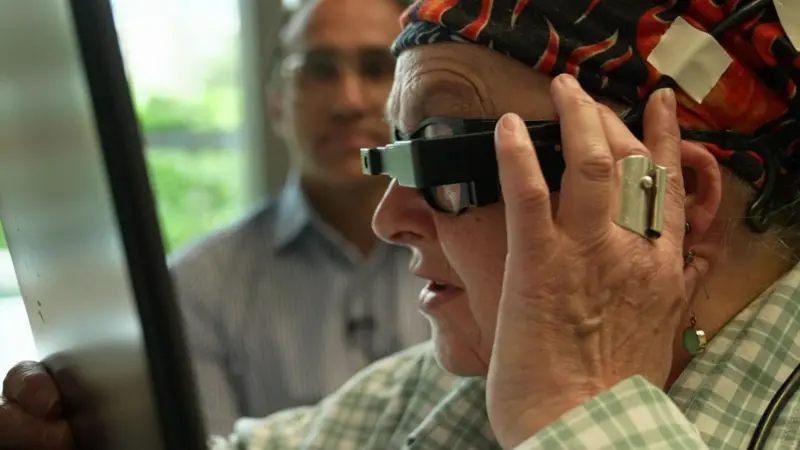
A remarkable medical breakthrough has given blind patients the chance to see again — thanks to a microscopic eye implant placed at the back of the eye. The results of this revolutionary procedure have left doctors, patients, and researchers amazed across the world.
A Life-Changing Invention
In a recent international clinical trial, doctors successfully implanted a tiny electronic chip in the eyes of several blind patients. The results were described as “astonishing” by the medical team involved.
One of the participants, 70-year-old Sheila Irvine, who lost her sight decades ago due to retinal degeneration, shared her joy:
“Being able to read and solve crosswords again feels like stepping into another world. It’s beautiful, it’s incredible. I’m so happy.”
The technology brings new hope to patients suffering from Geographic Atrophy (GA) — an advanced stage of dry age-related macular degeneration (AMD), which currently affects hundreds of thousands of people worldwide.
How the Implant Works
The innovation involves inserting a 2-millimeter-wide microchip, thinner than a human hair, beneath the retina.
Patients wear special glasses fitted with a miniature video camera. The camera captures visual data and transmits it to a small pocket processor, which then sends enhanced infrared signals to the implant. These signals stimulate the retina and transmit visual information to the optic nerve, allowing the brain to interpret images.
Through months of training, patients learn to interpret the visual signals, gradually regaining the ability to recognize shapes, text, and surroundings.
According to the lead surgeon, this implant represents a “major milestone in the journey to restore vision to the blind.”
“For the first time, patients with advanced retinal damage are able to read and perform daily tasks independently. It’s a life-changing innovation.”
Results of the Clinical Trial
The ongoing trial, conducted across multiple European countries, tested the implant—named PRIMA—developed by Pixium Vision in collaboration with Science Corporation, a biotechnology company based in California.
Out of 32 patients who received the implant, 27 regained partial central vision, and most were able to read letters and simple words again.
After one year, patients demonstrated the ability to identify up to 25 letters or five lines on a vision chart — an unprecedented achievement in visual prosthetic research.
Sheila, one of the first participants, described the experience as nothing short of a miracle.
“I could not read a single letter before. But now, I can read entire words. It’s something I thought I would never do again.”
The Patient’s Journey
Sheila’s eyesight began deteriorating nearly three decades ago. What started as mild blurriness slowly progressed to near-total blindness.
After receiving the implant, her daily life transformed dramatically.
“I can read my mail, books, and even solve Sudoku puzzles again,” she said.
To operate the device, Sheila rests her chin on a cushion to stabilize the visual feed and uses zoom functions to distinguish between similar letters like C and O.
Although she doesn’t use the device outdoors yet, she spends hours at home reading and regaining confidence in her independence.
“Technology has given me back something priceless — my ability to see and read again. I’m truly grateful.”
Availability and Future Possibilities
The PRIMA implant is still undergoing clinical evaluation and hasn’t yet received full regulatory approval or market pricing.
However, researchers are optimistic that it could be made available to patients within the next few years. If approved, it may become a revolutionary treatment for millions of people suffering from macular degeneration and other forms of retinal blindness.
Key Facts
Technology: PRIMA Retinal Implant
Purpose: Restoring central vision in patients with retinal degeneration
Developed By: Science Corporation (California) & Pixium Vision (France)
Trial Participants: 38 patients across 5 countries
Result: 27 regained measurable central vision
Conclusion
This innovation marks a historic milestone in medical science — giving blind patients the ability to see once again.
It not only restores vision but also restores confidence, dignity, and the joy of experiencing the world through one’s own eyes.
“Where science meets hope, miracles happen.”









Responses (0 )